Will AI Recommend Your Business? How to Show Up in ChatGPT and Google AI
Vince Systems · September 14, 2026 · local SEO system, AI search visibility, Google Business Profile optimization, ChatGPT local search, content gap SEO, review automation
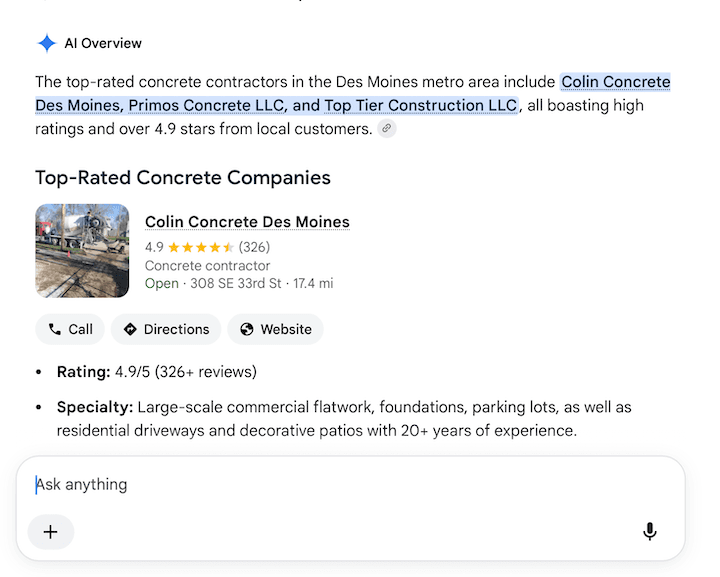
The Search Bar Is Not the Only Place Buyers Start Anymore
Somewhere right now, a homeowner in Columbus is typing into ChatGPT: "Who is the best HVAC company near me?" A clinic patient in Phoenix is asking Google's AI Overview to suggest a physical therapist. A remodeling prospect in Des Moines is asking Perplexity to compare roofing contractors.
None of those searches look like a traditional Google query. But they are all buying decisions. And if your business is not built on a strong local SEO system, you will not show up in any of them.
This post explains exactly how AI tools decide which businesses to mention, why the answer is the same foundational system you already need for Google Maps, and what you can do this week to improve your odds.
How ChatGPT and AI Overviews Actually Choose Businesses to Recommend
Most local business owners assume AI tools are a mystery. They are not. These tools pull from sources that already exist on the web.
ChatGPT's browsing mode and its training data lean heavily on:
- Review platforms like Google, Yelp, and industry-specific directories
- Business listings and citations that confirm you are a real, established company
- Blog content and Q&A pages that answer the questions buyers are already asking
- Local news mentions, press releases, and authority links
Google's AI Overviews pull from Google's own index, which means Google Business Profile data, reviews, structured on-page content, and trusted third-party sources.
Perplexity and other AI search tools crawl live web pages and prioritize sites with clear, specific answers to questions.
The pattern is the same across all of them. The businesses that show up are the ones with broad, consistent data across the web, strong review volume, and content that directly answers buyer questions.
That is a local SEO system. Not a trick. Not a prompt. A system.
Why Traditional SEO and AI Visibility Are Built on the Same Foundation
Here is what matters: you do not need a separate "AI SEO strategy." You need the same things you needed before, executed more completely.
Think about what ChatGPT references when someone asks for a roofing contractor recommendation. It looks for businesses with:
- Consistent name, address, and phone number across dozens of directories
- High review counts with real, specific detail in the text
- A website with pages dedicated to specific services and locations
- Content that answers the questions buyers actually search for
That is the exact same checklist that gets you ranked in Google Maps and Google's organic results. The difference is that AI tools reward breadth and consistency even more than traditional search does.
If your citations are incomplete, your reviews are sparse, and your site has one generic homepage, Google might still rank you if the local competition is weak. ChatGPT will simply skip you. There are no weak-competition shortcuts in AI recommendations.
The Five Parts of a Local SEO System That Drive AI Visibility
Below is the framework. Each part feeds the others. Skipping one creates a gap that AI tools notice even if Google sometimes forgives it.
1. Google Business Profile Built to Rank
Your Google Business Profile is the single most referenced source when Google's own AI summarizes local options. Fill every field. Choose the right primary category. Add service areas. Upload photos weekly. Post updates at least twice a month.
The specifics matter here. A profile that lists "General Contractor" as its category and has fewer than 25 reviews is nearly invisible to AI Overviews for competitive queries. A profile with the right category, 50-plus reviews with keyword-rich responses, service descriptions, and fresh photos is a different story.
2. Review Volume and Review Content
AI tools do not just count stars. They read the text. ChatGPT's training data includes review content from Yelp, Google, and dozens of vertical directories. The reviews that mention specific services, locations, and outcomes carry real weight.
A review that says "great service" helps a little. A review that says "fixed our AC fast, came to Westside Des Moines same day, very professional" gives an AI tool three data points: service type, location, and quality signal.
Review automation changes the math here. Most local businesses get reviews only when someone remembers to ask. A system that sends a review request by text within two hours of a job closing can triple review velocity without changing anything else about how you operate.
3. Citations Across the Right Directories
Citations are mentions of your business name, address, and phone number on other websites. Google uses them to confirm you are a legitimate local business. AI tools use them the same way.
The threshold that tends to move the needle: consistent NAP data on at least 40 to 60 relevant directories. That includes the big aggregators like Yelp, Apple Maps, Bing Places, and Angi, plus industry-specific directories for your trade.
Inconsistencies, an old address, a different phone number, a misspelled business name, create doubt. AI tools default to sources they trust. If your data conflicts, they often skip you entirely.
4. City and Service Pages on Your Website
This is where most local businesses have the biggest gap. A single homepage with a phone number is not a local SEO asset. It is a brochure.
Every city you serve needs its own page. Every service you offer needs its own page. Ideally, the two combine: a page for "Roof Replacement in Cedar Rapids" is more powerful than a generic "Roofing" page.
When an AI tool processes a query like "best roof replacement company near Cedar Rapids," it looks for pages that are specifically about that topic. A well-built city-service page with 400 to 800 words, local landmarks, and clear service detail gives it exactly what it needs to reference your business.
Building these pages is the part that stops most business owners. A full service area with 10 cities and 8 services means 80 pages. An AI blog writer built into your system makes this scalable without hiring a writer.
5. Content That Answers the Questions AI Gets Asked
Buyers do not just ask AI for a recommendation. They ask questions.
"How much does a bathroom remodel cost in Kansas City?" "What should I look for in a physical therapist?" "Is it worth repairing or replacing a 10-year-old furnace?"
If your site has a blog post that answers those questions with specific, accurate information, AI tools can and do cite or reference the content. Google's AI Overviews in particular pull featured-snippet-style answers directly from well-structured pages.
This is called content gap blogging. You find the questions your ideal buyers are already asking, questions your competitors have not answered well, and you publish clear, specific answers. Each post is a door into your business. Over time, a library of 30 to 50 posts covering real buyer questions makes your site a credible source that AI tools return to.
What AI Tools Are Looking for That Most Local Sites Are Missing
Beyond the five pillars, there are a few specific signals that AI tools weight heavily right now:
Structured data markup. Schema code on your website tells AI crawlers exactly what your business does, where you operate, and what your reviews say. LocalBusiness schema, Service schema, and FAQPage schema are the most useful for local service businesses. Most local sites have none of these.
Author and entity clarity. AI tools favor content connected to a real business with a verifiable history. Your about page, your Google Business Profile, your LinkedIn presence, and your directory listings all contribute to this. Faceless websites with no clear ownership signal are becoming less trusted.
Third-party validation. A mention in a local news article, a quote in an industry publication, or a listing in a curated local directory carries more weight than a citation you built yourself. Even one or two of these per year helps.
Response time and operational signals. Google's AI uses signals like whether you respond to reviews and questions, how current your hours are, and whether your site loads quickly. These operational details separate businesses that are actively managed from ones that are dormant.
How Long Does It Take to Show Up in AI Recommendations
This is the honest answer: most businesses start seeing measurable movement in three to six months when they work the system consistently. Some specific changes, fixing citation inconsistencies, completing the Google Business Profile, launching a handful of service pages, can move the needle in four to eight weeks.
AI tools are not static. ChatGPT's models update. Google's AI Overviews shift week to week based on the underlying index. Perplexity crawls new content regularly. The businesses that win long-term are the ones running the system every week, not the ones who do a one-time optimization and hope.
Consistency is the mechanism. Weekly GBP posts, monthly review pushes, quarterly content additions, and annual citation audits compound over time. That is how one local business grows to $3M in revenue without paid ads dominating the budget.
Get the free $3M Local SEO System playbook to see the exact steps laid out week by week.
What to Do Next
Here is a concrete starting point for this week.
1. Search for your own business name in ChatGPT and ask it to recommend businesses in your category and city. See what comes up and who is listed. 2. Check your Google Business Profile for completeness. Fill every field that is empty. 3. Count your Google reviews. If you are under 30, put a review request process in place before anything else. 4. Search Google for three questions your buyers commonly ask. Look at whether your site appears anywhere in the results. If it does not, you have a content gap to fill.
Those four steps will show you exactly where your local SEO system needs the most work. And if you want the full playbook that covers all five pillars in sequence, Get the free $3M Local SEO System playbook.
---
Frequently Asked Questions
Does my business need a separate strategy for AI search versus traditional SEO?
No. The same local SEO system that ranks you on Google Maps also gets you referenced by AI tools. Citations, reviews, service pages, and content all feed both channels. Businesses that try to chase AI-specific tactics without the foundational system in place tend to see little result.
Can a small local business with no technical background actually build this system?
Yes. The core tasks, completing a Google Business Profile, building citations, publishing service pages, collecting reviews, do not require coding or an agency. They require consistent weekly effort and a clear process. That is what the playbook is designed for.
How often do AI tools like ChatGPT update which businesses they recommend?
ChatGPT's training data updates periodically with new model releases, but its browsing mode pulls live data. Google's AI Overviews update continuously based on the search index. Perplexity crawls in near real-time. Running your local SEO system weekly gives you the best chance of being included whenever those updates happen.
The insider playbook
Get the $3M Local SEO System
Free PDF. The exact system behind one business at $3M and another at $600k — every step, in order.
Send me the playbookKeep reading
September 22, 2026
How Many Google Reviews Do You Need to Rank in the Map Pack?
Most business owners guess when it comes to Google reviews. This post gives you a concrete number to aim for and a system to get there.
September 20, 2026
How to Find Content Gaps Your Local Competitors Are Ignoring
Most local competitors leave obvious keyword gaps wide open. This guide shows you exactly how to find them and turn each one into a page that pulls in leads.
September 19, 2026
Why Your Competitor Ranks on Google Maps and You Don't
Your competitor does worse work but shows up first on Google Maps. Here is exactly why that happens and what you can fix this week.